
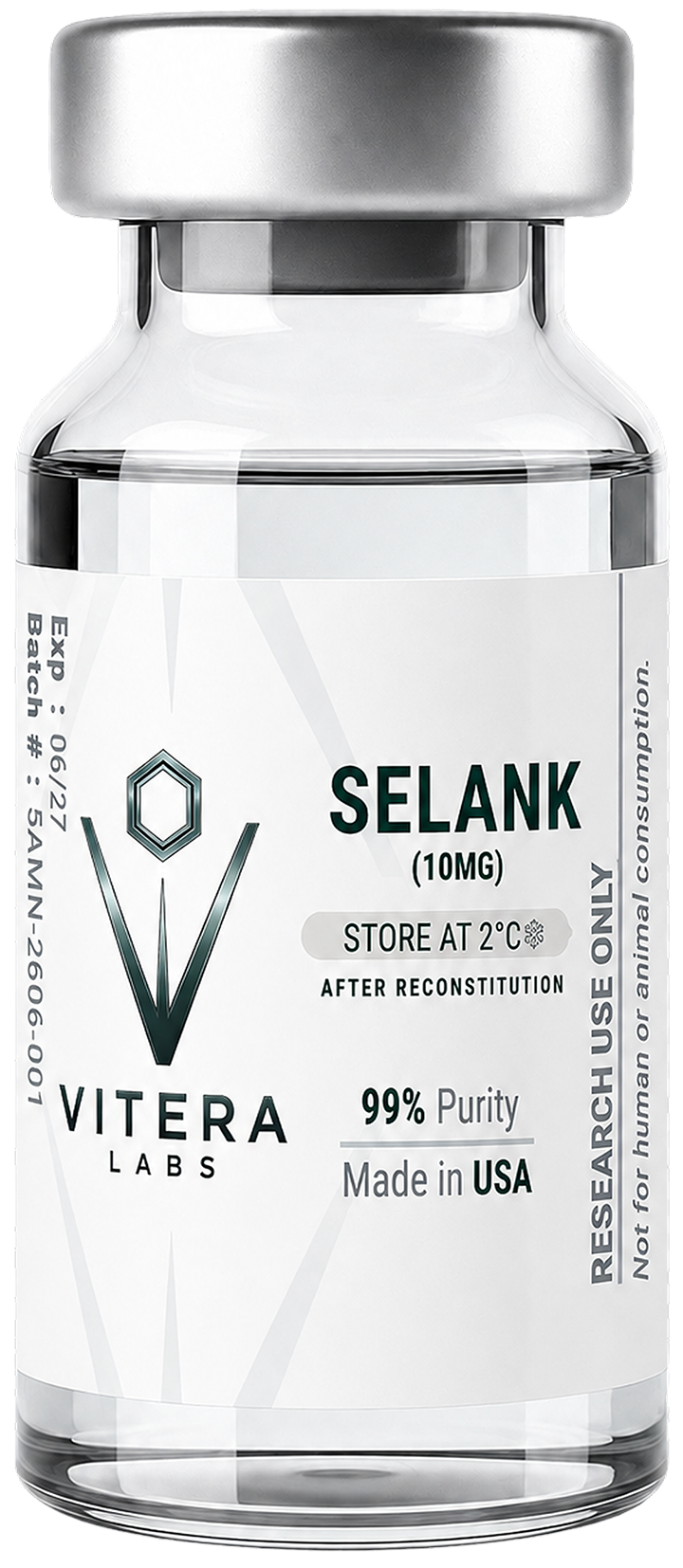

$105.00
You save (%)
Selank is a synthetic heptapeptide analog of the naturally occurring immunomodulatory peptide tuftsin, with an additional Pro-Gly-Pro sequence for enhanced stability. Developed at the Institute of Molecular Genetics of the Russian Academy of Sciences, research has investigated its anxiolytic, nootropic, and immunomodulatory properties. Studies suggest effects on BDNF expression and monoamine neurotransmitter balance.
10 in stock


These products are for laboratory research only and not intended for medical use. They must be handled by qualified professionals in controlled laboratory environments. This compound has not been evaluated by the FDA and is not approved for human or veterinary use.
These products are for laboratory research only and not intended for medical use. Qualified professionals in controlled laboratory environments must handle them. The FDA has not evaluated this compound, and it is not approved for human or veterinary use.
Third-party tested for purity, identity, and quantity.
VL-8583052
Selank is supplied as a lyophilized (freeze-dried) powder with purity typically ≥98%, as determined by HPLC. Each vial is accompanied by a certificate of analysis specifying purity, molecular weight confirmation, and batch identity. This format is standard for research-grade peptides intended for laboratory reconstitution and experimental use only.
Lyophilized Selank should be stored at -20°C in a desiccated environment, protected from light and moisture. Upon receipt, storage at -80°C is recommended for long-term archival in research settings. Repeated freeze-thaw cycles should be minimized to preserve peptide integrity. Reconstituted solutions should be aliquoted and stored at -20°C for short-term experimental use.
For research applications, Selank is commonly reconstituted in sterile physiological saline (0.9% NaCl) or phosphate-buffered saline (PBS) at concentrations appropriate to the experimental design. Gentle vortexing or rotation is recommended to achieve full dissolution. Researchers should consult the published literature for concentration ranges used in comparable preclinical model systems and adhere to institutional animal care and use protocols.
Published preclinical research has primarily used Wistar and Sprague-Dawley rat models, as well as mouse strains, in behavioral assays (elevated plus-maze, open-field, and learned helplessness paradigms), alongside ex vivo gene expression studies in hippocampal and cortical tissue. In vitro cytokine and immune cell assays have also been employed. Researchers are directed to the primary literature for detailed model-specific methodologies.
No. Selank supplied here is strictly for laboratory research and preclinical experimental use only. It is not approved by the FDA, EMA, or any equivalent regulatory authority as a therapeutic agent. It is not intended for administration to humans or for use in clinical, veterinary, or consumer applications.
Current research has focused on Selank’s interactions with GABA-A receptor complexes and benzodiazepine binding sites, BDNF/TrkB neurotrophin signaling pathways, enkephalin-degrading enzymes (leucine and methionine enkephalin catabolism), and cytokine regulatory networks including IL-6, TNF-α, and interferon systems. These targets are being explored in preclinical and in vitro contexts to characterize their mechanism of action.
Scientific research has identified several key areas where Selank shows promising applications.
These research findings represent ongoing studies and should not be interpreted as medical claims or recommendations.
These references are provided for research purposes only. Citations do not imply endorsement or approval of this product for any specific application.
