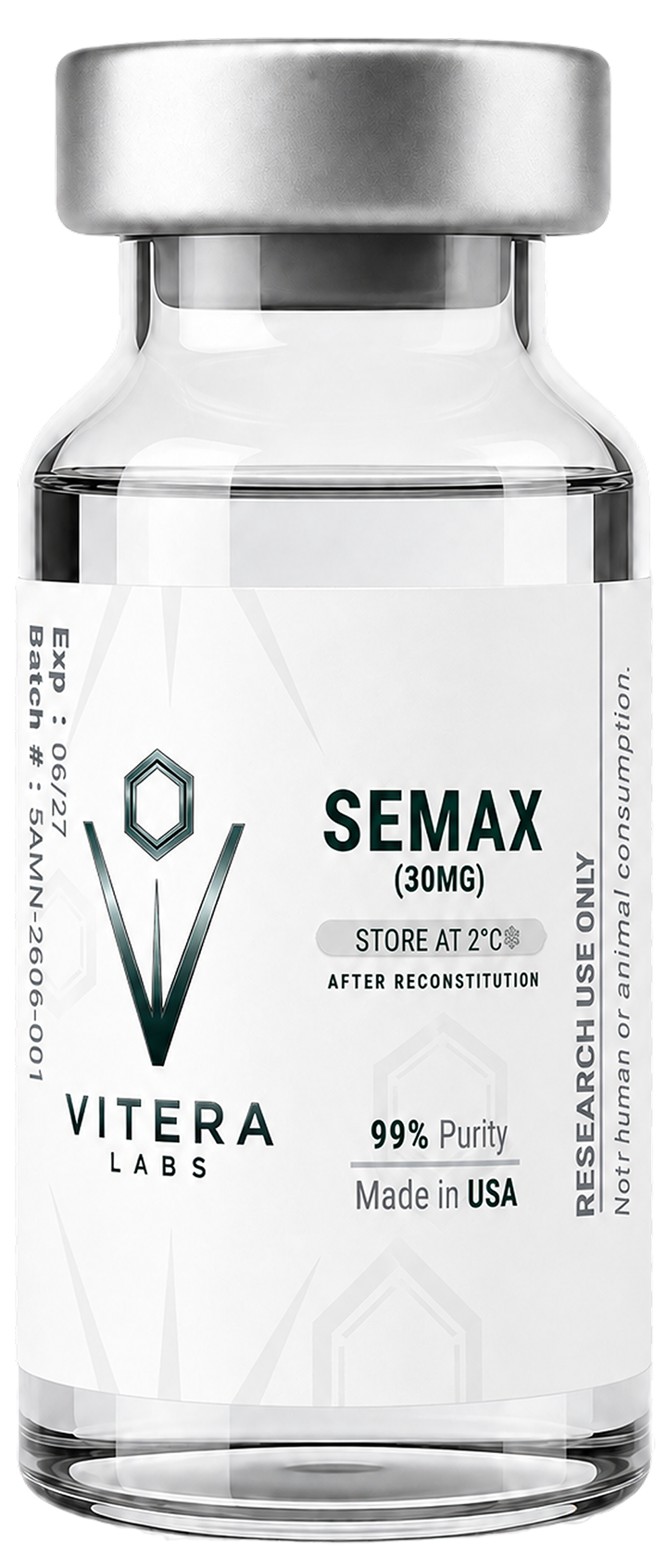
Semax is a synthetic heptapeptide derived from the N-terminal fragment of adrenocorticotropic hormone (ACTH 4-10) with a C-terminal Pro-Gly-Pro modification for enhanced stability. Originally developed as a neuroprotective agent, research has investigated its cognitive-enhancing, neuroprotective, and neurotrophic properties. Studies suggest effects on BDNF, NGF, and various neurotransmitter systems.
Made in USA
Batch Tested
Fast Shipping
24/7 Support
For Research Use Only
These products are for laboratory research only and not intended for medical use. They must be handled by qualified professionals in controlled laboratory environments. This compound has not been evaluated by the FDA and is not approved for human or veterinary use.
Description
Semax (30MG)
Technical Specifications
Purity≥99%
Form Lyophilized Powder
CAS Number80714-61-0
Molecular Weight813.93 g/mol
Storage-20°C
Third-Party Tested
99.45% Purity
Semax FAQ
Semax is supplied as a lyophilized (freeze-dried) powder with a purity of ≥98% as determined by HPLC analysis. A certificate of analysis (CoA) confirming purity, molecular weight verification by mass spectrometry, and peptide sequence is available for each batch. This material is intended solely for in vitro and preclinical laboratory research.
Lyophilized Semax should be stored at -20°C in a desiccated environment, protected from light and repeated freeze-thaw cycles. Under these conditions, the compound is expected to maintain stability for up to 24 months. Once reconstituted, aliquoting and storage at -80°C is recommended to minimize degradation in research applications.
For research purposes, Semax is commonly reconstituted in sterile phosphate-buffered saline (PBS) or sterile water. Researchers are advised to prepare working concentrations appropriate for their specific experimental model and assay requirements. Gentle vortexing or sonication may be used to achieve complete dissolution; avoid harsh agitation that could disrupt peptide structure.
Published preclinical research has employed Semax in Wistar and Sprague-Dawley rat models (including MCAO ischemia models), mouse behavioral paradigms (e.g., Morris water maze, passive avoidance), primary neuronal cell cultures, and microglial cell lines. These models have been used to investigate neurotrophic, neuroprotective, and cognitive-related signaling endpoints in a controlled laboratory context.
No. Semax supplied by this source is strictly a research-grade compound intended for laboratory and preclinical in vitro/in vivo research only. It has not been approved by the FDA or equivalent regulatory bodies for human therapeutic use, and no claims regarding safety or efficacy in humans are made. It must not be administered to humans.
Current research investigations focus on Semax’s interactions with melanocortin receptor subtypes (particularly MC4R and MC5R), TrkB/BDNF signaling pathways, p75NTR neurotrophin receptor, and downstream effectors including MAPK/ERK and PI3K/Akt cascades. Researchers also investigate its influence on inflammatory transcription factors NF-κB and AP-1 in CNS tissue models.
Scientific research has identified several key areas where Semax shows promising applications.
Key Areas of Research:
Cognitive:
•Memory consolidation
•Learning enhancement
•Focus modulation
•Neuroprotection
Neural:
•BDNF expression
•Neuroplasticity
•Dopamine pathways
•Nerve regeneration
Vascular:
•Cerebral blood flow
•Ischemia protection
•Endothelial function
Systemic:
•Anti-inflammatory
•Immune modulation
•Stress response
•Anxiety reduction
These research findings represent ongoing studies and should not be interpreted as medical claims or recommendations.
References & Citations
Liu R, Chen Y, Huang H. Semax peptide targets the μ opioid receptor gene Oprm1 to promote deubiquitination and functional recovery after spinal cord injury in female mice. Br J Pharmacol. 2025.PMID: 40692165
Rahman OF, Lee SJ, Seeds WA. Therapeutic Peptides in Orthopaedics: Applications, Challenges, and Future Directions. J Am Acad Orthop Surg Glob Res Rev. 2026.PMID: 41490200
Glazova NY, Manchenko DM, Volodina MA. Semax, synthetic ACTH(4-10) analogue, attenuates behavioural and neurochemical alterations following early-life fluvoxamine exposure in white rats. Neuropeptides. 2021.PMID: 33418449
Sciacca MFM, Naletova I, Giuffrida ML. Semax, a Synthetic Regulatory Peptide, Affects Copper-Induced Abeta Aggregation and Amyloid Formation in Artificial Membrane Models. ACS Chem Neurosci. 2022.PMID: 35080861
These references are provided for research purposes only. Citations do not imply endorsement or approval of this product for any specific application.