

$120.00
You save (%)
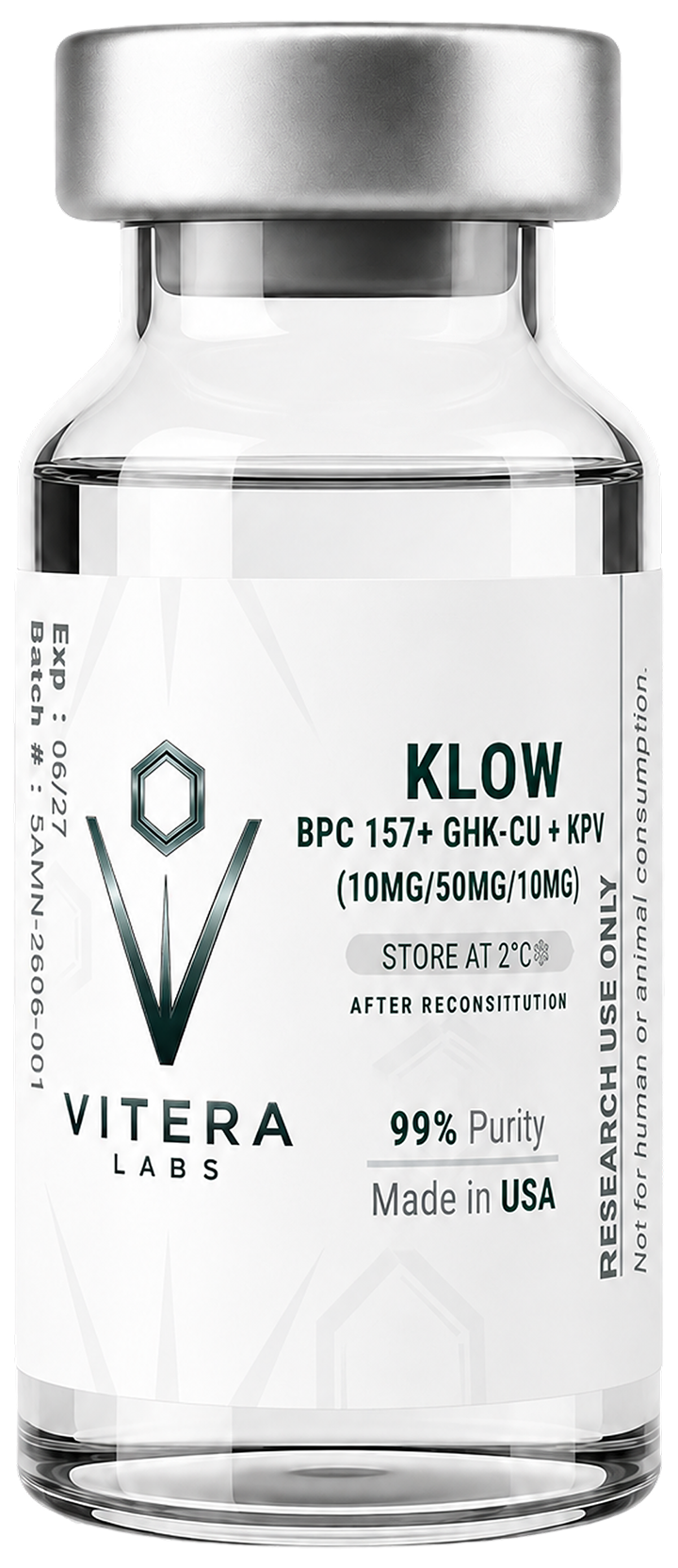
The GLOW Blend combines three synthetic peptides studied for their roles in cellular regeneration and repair processes: GHK-Cu, BPC-157, and TB-500. Together, these peptides are investigated for their influence on angiogenesis, extracellular matrix remodeling, and systemic repair pathways.
10 in stock


These products are for laboratory research only and not intended for medical use. They must be handled by qualified professionals in controlled laboratory environments. This compound has not been evaluated by the FDA and is not approved for human or veterinary use.
These products are for laboratory research only and not intended for medical use. They must be handled by qualified professionals in controlled laboratory environments. This compound has not been evaluated by the FDA and is not approved for human or veterinary use.
GLOW is supplied as a lyophilized (freeze-dried) powder blend of GHK-Cu, BPC-157, and TB-500. Constituent peptides are manufactured to ≥98% purity as assessed by HPLC and confirmed by mass spectrometry. A Certificate of Analysis (CoA) is available for each lot. This product is formulated exclusively for laboratory and research purposes.
The lyophilized GLOW blend should be stored at −20°C in a dry, dark environment upon receipt. Avoid repeated freeze-thaw cycles. Once reconstituted, working solutions should be aliquoted, stored at 4°C if use is anticipated within 48–72 hours, or returned to −20°C for longer-term storage in clearly labeled research aliquots.
For in vitro research applications, the lyophilized blend is typically reconstituted using sterile bacteriostatic water or an appropriate aqueous buffer (e.g., PBS pH 7.4), depending on the assay requirements. Researchers should consult their institutional protocols and relevant literature for vehicle selection appropriate to specific cell or assay systems. This product is not formulated or tested for any route of human administration.
GHK-Cu has been investigated in fibroblast, keratinocyte, and neuronal cell culture systems, as well as in wound-healing animal models. BPC-157 has been studied across rodent models of gastrointestinal injury, tendon/ligament repair, and systemic organ protection. TB-500 (Thymosin Beta-4 fragment) has been examined in cardiac, corneal, and skeletal muscle repair models in rodents, as well as in endothelial cell angiogenesis assays. The GLOW blend is intended for analogous in vitro and preclinical research contexts only.
No. GLOW is strictly a research-grade peptide blend supplied for in vitro and preclinical laboratory investigation only. It has not been evaluated by any regulatory authority for safety or efficacy in humans, is not approved for human or veterinary therapeutic use, and must not be administered to humans or animals outside of formally approved research protocols.
Key molecular targets of research interest across the three components include: copper-mediated regulation of antioxidant enzyme expression and ECM gene transcription (GHK-Cu); nitric oxide synthase (NOS) pathway modulation, VEGFR2 engagement, and EGF receptor signaling (BPC-157); and G-actin sequestration, integrin-linked kinase (ILK) activation, and VEGF upregulation (TB-500/Thymosin Beta-4 fragment). These targets provide a mechanistic framework for designing multi-pathway signaling experiments using this blend.
Scientific research has identified several key areas where GLOW shows promising applications.
•Collagen synthesis
•Melanin regulation
•Skin elasticity
•UV protection
•Antioxidant activity
•Cell renewal
•Oxidative stress reduction
•Microcirculation
•Nitric oxide pathways
•Skin perfusion
•Wound healing
•Tissue repair
•Matrix remodeling
These references are provided for research purposes only. Citations do not imply endorsement or approval of this product for any specific application.