

$159.00
You save (%)
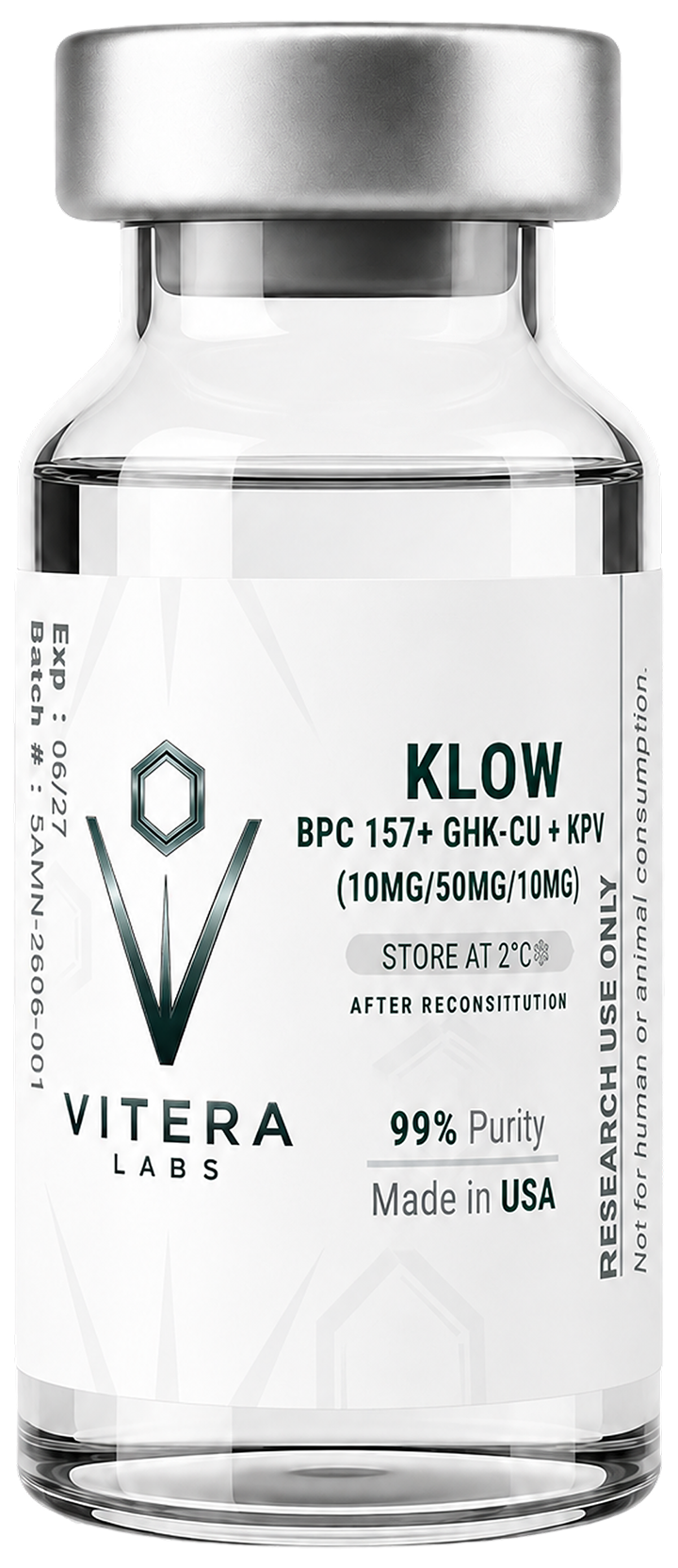
The KLOW Blend combines GHK-Cu, BPC-157, TB-500, and KPV into a single formulation studied for its potential influence on cellular repair and systemic regulation. The inclusion of KPV supports immune regulation and anti-inflammatory pathways.
8 in stock


These products are for laboratory research only and not intended for medical use. They must be handled by qualified professionals in controlled laboratory environments. This compound has not been evaluated by the FDA and is not approved for human or veterinary use.
These products are for laboratory research only and not intended for medical use. They must be handled by qualified professionals in controlled laboratory environments. This compound has not been evaluated by the FDA and is not approved for human or veterinary use.
The lyophilized KLOW blend should be stored at −20 °C in a desiccated environment, protected from repeated freeze-thaw cycles and light exposure. Under these conditions, the peptide components are expected to remain stable for up to 24 months. Once reconstituted, aliquots should be stored at 4 °C and used within a timeframe consistent with standard peptide handling protocols for each component peptide.
For laboratory use, KLOW is typically reconstituted in sterile bacteriostatic water or an appropriate aqueous buffer (e.g., PBS, pH 7.4). GHK-Cu is water-soluble; however, researchers should note that copper-chelated peptides may exhibit different solubility characteristics at varying pH. It is recommended to consult the individual solubility data for each constituent and prepare fresh working solutions or aliquots as required by the specific experimental protocol.
The four constituent peptides have been studied across a range of preclinical models: KPV has been evaluated in murine colitis models and epithelial cell lines; GHK-Cu has been studied in human fibroblast cultures, gene expression arrays, and CAM assays; BPC-157 has been investigated extensively in rodent tendon, gastrointestinal, and vascular injury models; and TB-500 has been examined in rodent cardiac, skeletal muscle, and wound-healing models. KLOW as a defined blend has not been independently characterized in the peer-reviewed literature to date and is provided to support novel investigational research.
No. KLOW is strictly a research compound intended for in vitro and preclinical laboratory use only. It is not approved, licensed, or intended for administration in humans or animals, and is not classified as a drug, supplement, or therapeutic agent. Researchers must comply with all applicable institutional, national, and regulatory guidelines governing the handling and use of research peptides.
Key molecular targets associated with the blend components include: MC1R and MC3R (KPV); copper-dependent metalloenzyme interactions, SPARC, and p53 signaling nodes (GHK-Cu); VEGFR2, FAK-paxillin, and nitric oxide synthase pathways (BPC-157); and G-actin sequestration via β-thymosin repeats and LIMK/cofilin pathways (TB-500). These targets collectively span inflammatory, angiogenic, and cytoskeletal signaling networks and represent the primary mechanistic focus areas for KLOW blend research.
The KLOW Blend combines GHK-Cu, BPC-157, TB-500, and KPV into a single formulation studied for its potential influence on cellular repair and systemic regulation. The inclusion of KPV supports immune regulation and anti-inflammatory pathways.
Scientific research has identified several key areas where KLOW shows promising applications.
These research findings represent ongoing studies and should not be interpreted as medical claims or recommendations.
These references are provided for research purposes only. Citations do not imply endorsement or approval of this product for any specific application.

